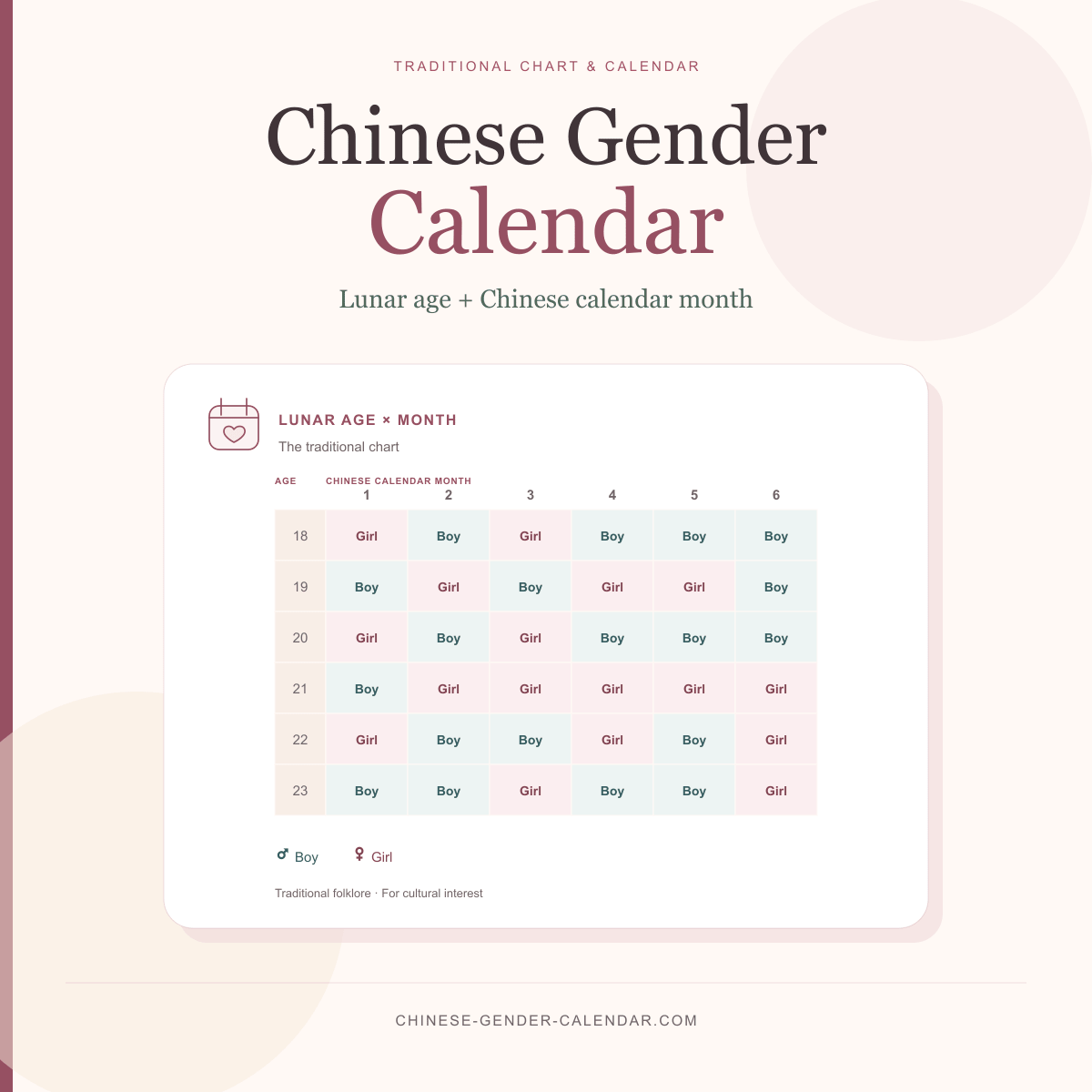
Two traditional inputs
The chart pairs the mother’s lunar age at conception with the lunar month of conception. Our calculator finds both for you.
A gentle way to explore a little pregnancy tradition. Discover the chart’s Boy or Girl label from the mother’s lunar age at conception and the lunar month of conception—we’ll handle the calendar math for you.
Share two dates and let us take care of the calendar conversions. Your result comes with a clear explanation of every value used.
Private by design. Your dates never leave this page.
Your result will appear here with the lunar age, conception month, and date conversion explained.
No sign-up. Nothing saved.According to traditional Chinese folklore.
This folklore method gives one possible result based on traditional rules.
This estimated date is close to a lunar-month boundary. A small change in the actual conception date could select a different chart column.
See how we calculated thisIncludes your converted dates and calculation details. Created on this device.
For cultural interest and entertainment only. This chart has no scientific or medical basis and cannot reliably determine a baby’s biological sex.
The chart pairs the mother’s lunar age at conception with the lunar month of conception. Our calculator finds both for you.
Research has not shown that the chart reliably predicts biological sex. Enjoy the result as folklore, not an answer.
A qualified healthcare professional can explain appropriate prenatal screening and ultrasound options, including their limitations.
The Chinese Gender Calendar is a folklore table that assigns a Boy or Girl label using the mother’s lunar age and the lunar month of conception.
You may also see it called a Chinese gender chart, Chinese gender predictor, or Chinese birth chart. These names usually refer to the same kind of age-and-month grid. It is not a medical test, and the online chart should not be confused with traditional Chinese medicine.
The calendar conversion is real and worth doing carefully: the traditional Chinese calendar is lunisolar, with its own New Year and 29- or 30-day months. The chart’s predictive ability is a separate question—and scientific research does not support it.
See the complete traditional chartTraditional Chinese nominal age starts at one at birth and increases at Chinese New Year. We compare the lunar years containing the birth and conception dates, including January and February boundaries.
The Gregorian conception date is converted to its Chinese calendar month. Gregorian months are not chart columns. A leap month uses the same column as the regular month it repeats.
The chart has rows for lunar ages 18–45 and columns for lunar months 1–12. The selected cell contains the traditional Boy or Girl label—nothing more.
A 2010 population-based study compared the method with 2,840,755 singleton births and found it performed no better than chance. A correct chart lookup can be fun to share, but it cannot reliably predict a baby’s biological sex.
Think of it as a lighthearted moment with family or a conversation at a baby shower—not a basis for shopping, medical care, or family decisions.
Read our honest accuracy reviewThey can explain which options are appropriate for you, what each test is for, and its limitations.
Read ACOG’s patient guidanceStories often connect the chart to a Qing palace or an ancient royal tomb. They make an intriguing tale, but no verifiable original document establishes that history. Some historians question the ancient-origin account and suggest that popular media and the internet may have played a much larger role in spreading the chart we see today.
The Chinese calendar itself has a long, sophisticated documented history. That does not prove the origin—or the accuracy—of this particular gender table.
Explore the history and legendsIt is a folklore chart that pairs the mother’s lunar age at conception with the Chinese calendar month of conception. It returns a traditional Boy or Girl label, not a medical prediction or a reliable way to determine biological sex.
The traditional chart matches the mother’s lunar age at conception with the lunar month of conception. Their intersection contains a Boy or Girl label. The calculator performs both calendar conversions for you.
First calculate the mother’s lunar age at conception. Next convert the conception date to its Chinese calendar month. Then find the cell where that age row and month column meet. Our calculator does all three steps from two Gregorian dates, or you can use the complete chart and annual month tables.
No. A 2010 population study of 2,840,755 births found the method performed no better than chance. It is a folklore activity, not a medical test or a reliable way to determine a baby’s biological sex.
You can estimate it from the first day of your last menstrual period by adding 14 days, or from an estimated due date by subtracting 266 days. These are approximations, especially when cycles vary.
This site uses the common online convention of assigning a leap month the same chart column as the regular month it repeats. Leap sixth month therefore uses month 6. No single historical rule is universally established.
The widely circulated chart uses traditional Chinese nominal age: a baby is counted as one at birth, and age increases at Chinese New Year. This differs from Western age, which starts at zero and increases on birthdays.
No. The calculators run entirely in your browser. This site does not transmit your calculator inputs to an application server, save them in cookies, or keep them after you leave or refresh the page.